



- Halt! (Unless you’re a certain type…) - 16th September 2026
- From Russia without love part two - 15th September 2026
- ‘We don’t need no educashun…’ copyright Pink Floyd - 14th September 2026
As Phil has written many times a free and independent media is essential, although this does not exist in many states around the world, and today new evidence is emerging that an internet blackout prevented news coming out that although the protests in Iran may have been quashed for now, it was done by using the tool of mass killings (including of many journalists as well as children).
Many more than previously thought were killed in Iran during the suppression of the enormous protests there, and the crackdown involved an internet blackout which curbed an independent media, so the world would not be told the actual figure.
But piecing together evidence from medical and other sources, an awful rough total becomes clear.
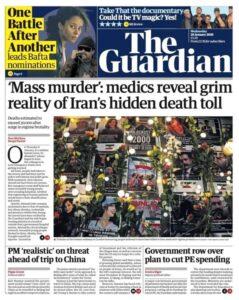 It’s been reported that at least 12,000 people have been killed, making this brutality the largest killing in the country’s contemporary history, much of it carried out on January 8 and 9.
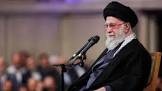
The killing was executed on the direct order of Supreme Leader Ali Khamenei, with the explicit knowledge and approval of the heads of all three branches of the Iranian Government, and with an order for live fire issued by the Supreme National Security Council.
Individual details tell a harrowing story.
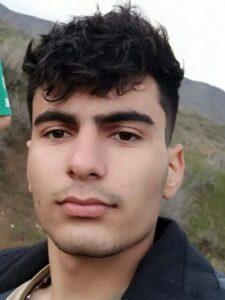
Reza Moradi was 17 — the eldest child in his family which hails from the Abdolvand tribe, part of Iran’s Lur minority. He was shot on Thursday, January 1 during protests outside Azna’s central police station.

Security forces shot him twice, a source close to the family said: once in the head and once in the lower torso.
Hessam Khodayarifard was shot dead in the western Iranian city of Kuhdasht on New Year’s Eve.
Another source, Amnesty International (Amnesty) declared: ‘On 21 January 2026, Iran’s Supreme Council of National Security issued a statement that 3,117 people were killed during the uprising.
‘However, on 16 January 2026, the UN Special Rapporteur on Iran, Mai Sato, said in a media interview that at least 5,000 people had been killed.
‘Amnesty International calls on the Iranian authorities to immediately restore internet access; release all those arbitrarily detained; disclose the fate and whereabouts of all those subjected to enforced disappearance; protect all detainees from torture and other ill-treatment; and grant detainees access to their lawyers, families and any medical care they require. Authorities must also stop the intimidation and harassment of victims’ families.
‘…In a briefing circulated to diplomats in Geneva on 19 January 2026, Iran’s Permanent Representative sought to portray the protests as a foreign-engineered “security threat” in an attempt to avoid international scrutiny. The briefing also falsely claimed that the authorities have “refrained from adopting a broad or indiscriminate hard-security approach” in the aftermath of the uprising, justifying the sweeping internet shutdown as a ‘public safety’ measure.
In the light of the ferocity exhibited by security forces being revealed, The Eye here re-publish our story about this appalling episode:
*
If anything underlines the importance of a free media, it is now in Iran which has been rocked by enormous protests, but where it is difficult to establish what exactly is happening.

We know that perhaps 2,000 people have been killed (according to one official) but even this figure may be on the low side, as the authorities tighten the screw of repression.
In some quarters a figure of 20,000 has been mentioned.
The protests were triggered by rising public anger over the skyrocketing prices of basic goods, but they also reflect the growing disenchantment among ever-larger sections of society with the Islamic Republic’s political system.
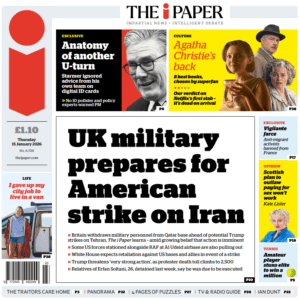 One brave demonstrator, Erfan Soltani, was reportedly to be executed today, and a human rights group has declared that they “have never witnessed a case move so quickly”.
Iran has just insisted, though, that he had never been sentenced to death, so perhaps (if it is reality) the authorities were put off by the wrath of Donald Trump (see story soon about how he is ridiculously now eyeing up Greenland), and the snatching of Nicolas Maduro.
But, frankly, it is very hard to find out the truth, although it is clear that events are moving quickly.
Iranians are accustomed to losing access to phone and internet services during unrest, with the internet cut off during major protests in 2019, and in another big wave of demonstrations in 2022.
But the current blackout is worse than anything experienced before.
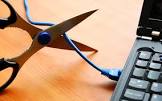
On January 8 internet connectivity fell to just one per cent of its normal levels, where it has remained.
That has left Iranians struggling to communicate with each other and to get news of the uprising (as well as the increasingly bloody crackdown), to the outside world.
It is a problem making a definitive judgment about the situation on the ground because Iran has successfully clamped down on information flowing out of the country.
The regime is well practised at severing its digital links with the outside world and it does so in several ways.
One is to manipulate something called the Border Gateway Protocol, which determines how the global internet connects to the Iranian one.
Another is to look at the individual packets of data traveling over networks, blocking those associated with Virtual Private Networks (VPNs) which typically allow Iranians to access otherwise forbidden sites, while still allowing access to government ones.
Iran also operates a domestic internet, a state-controlled network, that allows it to maintain some services so that the country is not plunged into the analogue age even during blackouts.
But some VPNs, which appear OK, are thought to be run by the Iranian government as traps.
These are the modern versions of censorship, but there are plenty of other more traditional ones the rulers also employ.
A free and inquiring website like The Eye is not allowed (officially!) in Iran.
But it’s important…
–
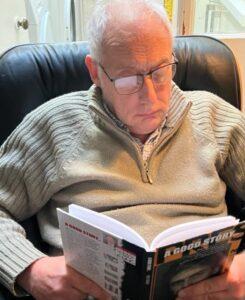
The memories of Phil’s astonishing 42 year award-winning career in journalism (when he was able to operate in a largely free environment) as he was gripped by the rare neurological disabling condition, Hereditary Spastic Paraplegia (HSP), have been released in a major book ‘A GOOD STORY’. Order the book now!
Next week – why disturbing news that BBC executives are planning to spend millions on taxis, puts centre stage how the giant corporation has also hit the headlines for all the wrong reasons following numerous scandals, but they REFUSE to answer The Eye’s questions about them.