

- A tartan death wish… - 17th March 2026
- Hitting more turbulence - 17th March 2026
- Dark speak easy part three - 16th March 2026
During 23 years with the BBC, and in a 42 year journalistic career (when he was trained to use clear and simple language, avoiding jargon), for our Editor, Welshman Phil Parry, analysing key political events has always been fundamental, and the budget was a prime example, when the previous administration was blamed, and it was important as much for what it DIDN’T mention as for what it did.
You must look at what politicians say (or omit to say) very carefully, and how they will often blame mistakes on a previous administration (of a different party).
Let me give you some examples.
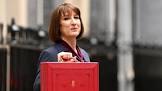
Analysis identifies 28 instances where the Chancellor Rachel Reeves, blamed the previous Tory administration in last week’s budget.
That is even more ‘mudslinging’ than during her maiden budget speech in October 2024, when she blamed the Tories 20 times (more than any Chancellor).

Contrast that with the relative magnanimity shown by Geoffrey Howe in 1979, after the country had been bailed out by the IMF – he blamed the previous UK Government just 10 times during his maiden speech.
It is common for chancellors to face bad headlines immediately after a budget, but rare to confront them so many days later.
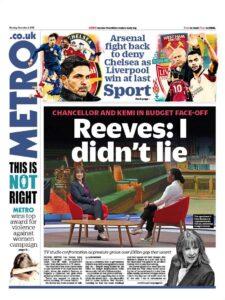
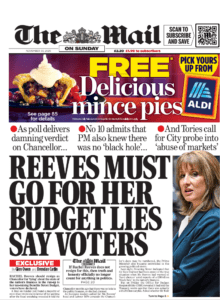 There have, though, been an enormous number of accusations that Ms Reeves had ‘lied’ over a huge financial black hole which needed filling.
Economists who check the UK Government’s numbers claim she knew the hole was actually much smaller than expected, more than two months ago.
Here’s what is alleged to have happened: there were warnings ahead of the budget that Ms Reeves could face as much as a £20 billion gap in meeting her self-imposed fiscal rule of not borrowing for day-to-day spending, making the tax rises all the more urgent.
 But a letter from the Office for Budget Responsibility (OBR) published on Friday revealed that it had told the Chancellor as early as September 17 the gap would be much smaller than expected, and the organisation later informed her in October the spending gap had closed altogether, with her even running a surplus.
However the OBR has not come out of other aspects of the budget saga well either, and its head was forced to resign earlier this week over a leak.
Richard Hughes had come under fire after the fiscal watchdog’s forecast – and all the major budget policies – appeared online ahead of Ms Reeves’s announcement.
 In the wake of the fiasco, Mr Hughes had said he would abide by the recommendations of the inquiry his organisation launched, and that he would serve only as long as he had the confidence of the Chancellor.
I am reminded of the ‘omnishambles’ budget of George Osborne, with his ‘pasty tax’.
But there were also a number of missed opportunities in Ms Reeves budget. I shall concentrate, though, on just one of them – money for mental health support.
OK, there were several announcements which could have an indirect effect, such as action on online gambling, and reducing energy bills, but nothing DIRECT.
 Indeed Mark Rowland, Chief Executive Officer (CEO) at the Mental Health Foundation (MHF), declared: “In a context of rising mental health needs…missing were clear commitments to increased funding for mental health prevention and support, which remain critical to tackling the UK’s mental health crisis”.
In Wales the situation could be particularly difficult, as the country has been hit extremely hard by de-industrialisation, and the jobless rate is higher than the UK average.
Both of these things have an enormous impact on mental health.
Figures published last month reported that the level of unemployment in Wales was 5.7 per cent in the three months to September, when the UK rate is five per cent.

It is clear that worrying about where your next pay cheque might come from, has a terrible effect mentally.
Historically cash support for mental health has not been brilliant in Wales, and a report about it a year ago highlighted this issue, especially in relation to younger people.

 A disturbing document published by the Healthcare Inspectorate Wales (HIW), and Estyn emphasised this appalling issue.
 Their findings revealed that many children and young people struggle to access the help they need, outlining:
- Ineffective support: Some children and young people were missing out on timely and effective support.
- Gaps in specialist care: Despite shorter waiting times for initial
Child and Adolescent Mental Health Services (CAMHS) assessments, follow-up care remained a major challenge for all children and young people. This was particularly the case for those with complex needs, including neurodiverse young people, who were often left without care when needed.
- Disparity in service access: There were disparities with the eligibility criteria and thresholds for accessing CAMHS, leaving many families and professionals frustrated by poor communication and lack of clarity around how these decisions are made. Those who spoke Welsh were not easily able to converse in their language of choice for mental health care and support.
- Rise in crisis support: New initiatives like Sanctuary Spaces and Crisis Hubs were providing alternatives to emergency room care for children and young people in crisis, but high demand meant many were still only accessing support there when they reached breaking point.
- Funding issues etc: Significant funding concerns have emerged, there are poor communication between services, and coordinated care is lacking. The report calls for stronger partnerships between health and local authorities to ensure that children and young people get the right care at the right time.
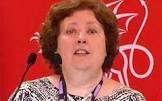
The Chief Inspector of Care Inspectorate Wales (CICW), Gillian Baranski proclaimed: “Mental health support for our children and young people is not just a statistic; it’s a call to action. It’s deeply concerning that over half of Wales’s children and young people don’t know where to turn for help…”.
Quite apart from the mental health support failures for younger people in Wales, the help for adults with mild to severe psychiatric needs has been little better.

One mental health charity stated worryingly on its website earlier this year: “It is with a deep regret that we announce that Time to Change Wales, our national anti-stigma programme will come to an end on the 31 March 2025. This is due to not being able to secure continuation funding beyond this current phase. Since its inception in 2012, this programme has been instrumental in raising awareness, supporting individuals, and advocating for change in the way mental health is perceived and discussed across systems and society”.
Families of patients at Tawel Fan Mental Health Unit in Ysbyty Clwyd were told that their loved ones had been filmed crawling across floors (by a UK newspaper) before the building was demolished, and a report into the scandal in 2015 said that there had been “institutional abuse”.
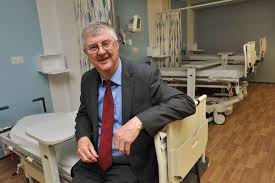
The former First Minister of Wales (FMW) and present Finance Minister, Mark Drakeford, was the Welsh Government (WG) Minister for Health and Social Services at the time of the scandal, so he is in the firing line.
After the revelations he apologised and said there would be an “urgent meeting”, which has always seemed to me the least that should have been done in the circumstances!
I feel extremely strongly about this because I have suffered mental health issues myself in the past – I was diagnosed with depression in 2010 which lasted for several months, and I have written about it in my book.
So watch how many times politicians blame the previous administration, and what they say – or don’t say!
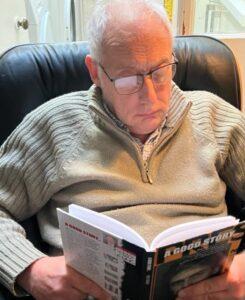
The memories of Phil’s astonishing award-winning career in journalism (when, apart from revealing his own mental issues, he often covered many health care controversies), as he was gripped by the rare neurological disabling condition, Hereditary Spastic Paraplegia (HSP), have been released in a major book ‘A GOOD STORY’. Order the book now!
It would make a good Christmas present – Nadolig Llawen!
Tomorrow – how during that career for Phil, exposing huge political and strategic errors, has always been a mainstay of his journalism, and this is now underlined by a new book about the brilliant scientist Francis Crick.