







- Another kill zone - 6th October 2026
- War games part one - 6th October 2026
- Poll to poll - 5th October 2026

The retention and growing success of Audit Wales (AW), have highlighted increasing criticism of a controversial decision by the Conservative-led coalition UK Government years ago, to scrap the accountancy watchdog for English councils.
In the latest edition of Private Eye this act was described as “shortsighted”, while a report by academics last year, declared that it had led to soaring costs and chaos.
The abolition of the Audit Commission (AC) (which monitored England’s council spending, but whose activities have now been outsourced) promised annual savings of £100 million, yet fees have rocketed amid a financial crisis.
The Audit Reform Lab at Sheffield said the average cost of external auditors checking a local authority’s finances was now at least £50,000 higher in cash terms than when the AC was disbanded in 2015.
 The agency was abolished as part of an austerity-driven push by Tory and Lib Dem ministers to find savings and efficiencies.
“Ten years on, however, it now seems clear that these reform ambitions have failed”, the authors of the report wrote.
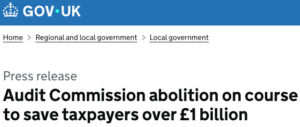 “Only 1% of audits were delivered on time in 2022-23, with many audits delayed by several years. Audit costs have risen dramatically in response. An unwieldy, but ultimately operational centralised bureaucracy was replaced by market chaos. The £100m per annum savings heralded by the UK government in 2014 are now a distant memory”.
The report found that average audit costs in England had more than tripled (an average increase of 238 per cent), in the year to 2023-24. It blamed most of this increase on private-sector auditors hiking their rates.

It compared the large rise in audit costs in England to much smaller increases in Scotland and Wales, where it said there was a much stronger level of central oversight of private-sector auditing.
AW’s role may also have been significant.
It declares on its website: “Our commitment to high audit quality underpins all our work and decision making”.
Market forces have come into play, and the increasing complexity of looking at the books of councils, have meant that auditors have faced severe economic headwinds.
 In 2020, an independent review by Sir Tony Redmond found that fees were “at least 25% lower than required to fulfil current local audit requirements effectively”.
Birmingham City Council paid an audit fee above the £1 million mark, representing a 314 per cent increase, and in total 13 English councils had fee scale increases of 300 per cent or more in 2022.
The breakdown in local audit in England reached crisis point three years ago when only one per cent of councils had their 2022-23 accounts signed off in time.
Ministers then allowed accounts to be completed with qualifications (whereby an auditor signed them off but expressed reservations), in order to clear the backlog.
Perhaps officials need to take a look at what is happening in Wales, where the accounts of public bodies are signed off in time, and effectively…

Truths like these by our Editor, Welshman Phil Parry, who was gripped by the rare neurological condition Hereditary Spastic Paraplegia (HSP), have been released in a major book ‘A GOOD STORY’. Order it now!
Tomorrow – campaigners want cleaner waterways in Wales after a landmark legal case to protect the rivers Wye, Lugg and Usk – the biggest ever claim of its kind, but which opponents say is “based on a misunderstanding”.