








- Halt! (Unless you’re a certain type…) - 16th September 2026
- From Russia without love part two - 15th September 2026
- ‘We don’t need no educashun…’ copyright Pink Floyd - 14th September 2026

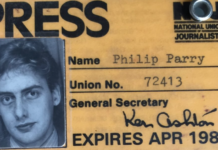
During 42 years in journalism, and especially on The Eye, our Editor, Welshman Phil Parry, has often been faced with spurious legal threats.
Targets have invariably been quick to turn to the law when uncomfortable facts are revealed about them, but new evidence suggests the backlog in cases for other people facing legal challenges remains high, although UK ministers are keen to emphasise a slight reduction today in one area.
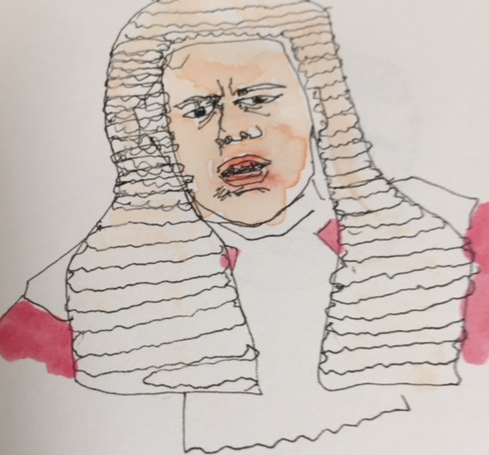
‘Justice delayed is justice denied’.

This is a legal term stressing that prolonged, excessive delays in legal proceedings causes immense harm, often prompts financial ruin, creates a system prone to a loss of evidence, and undermines public confidence in the rule of law.
It is usually attributed to William Gladstone in 1868, but the maxim could apply today just as well, because UK Government ministers are keen to trumpet a slight decrease in one area (county court cases), while the situation remains dire in other sections.

Earlier this month, the Minister of State for Courts Sarah Sackman declared: “Headway is finally being made” in reducing (slightly) the delays in county courts.
The latest civil justice statistics showed that the median time taken for small claims to go from issue to trial in 2025 was 39.3 weeks, nearly four weeks faster than in 2024.
For fast, intermediate and multi-track claims, it was 60.7 weeks, 6.2 weeks quicker than the previous year, but this is still an incredibly long time I would suggest, and little headway has been made in relation to criminal cases.

Ms Sackman commented: “We inherited a courts system in crisis, with many people facing far too long a wait for their civil case to reach trial. But our plans are working, and headway is finally being made. The figures show claims are being processed faster by more than six weeks compared to this time last year – delivering on our promise of swifter justice and a fairer system.”
Yet this information should be put in context.


Matthew Maxwell-Scott, Executive Director of the Association of Consumer Support Organisations, noted the UK Government’s focus on the median wait time, rather than mean, which results in “those facing particularly long delays… seeing their cases excluded from the numbers”.
He said: “… on a like-for-like basis things seem way off where they were before Covid struck.
“In order for these statistics to be credible, the MoJ (Ministry of Justice) needs either to stick to one set of numbers or provide the missing data for median waits, as these only go back to 2022.
“Even looking at the more favourable interpretation, people are waiting more than a year when it comes to more serious cases and around nine months for a small claim.

“But the experience for many claimants will be far worse than this and they may understandably not be very impressed by the government’s statistical gymnastics here.”
This terrible legacy of Covid-19 restrictions means that it can take months in criminal jurisdiction, from a charge being laid to acquittal or conviction – and remember that a person is innocent until proven guilty, so during all that time he or she will be living under a cloud.

A fair and functioning justice system is a key reason why England and Wales (where the legal system is the same unlike in Scotland), is seen around the world as a jurisdiction of choice for people to resolve their disputes.
The situation is even worse in other countries, and the Centre for Policy Research, an Indian think-tank, estimates that each ownership of property case there takes an average of 20 years to resolve.
That’s worth repeating, because it sounds like Jarndyce v Jarndyce, a probate case in Bleak House by Charles Dickens – 20 YEARS!

 This ridiculous delay is set against the incredible speed with which lawyers respond (when they are being paid presumably), by sending out obnoxious letters to me using impressive sounding words, alleging defamation or similar.
These letters invariably begin: “We act for xxxx”, and cost a few hundred pounds, but come quickly, and the empty legal threats I constantly receive (which cost nothing) are even swifter in arriving.
Here’s one I was sent recently: “I am currently preparing an evidence file, with legal input, for submission to South Wales Police (this would be a civil case anyway, NOT a criminal one!)“.
This person has also proclaimed menacingly: “I am writing to formally notify you of my intention to pursue legal action against you for defamation in connection with articles published about me on The Eye website, and to raise serious concerns that your conduct may also constitute harassment under the Online Safety Act 2023

“To avoid formal legal proceedings, I require the following actions to be taken within 14days of the date of this letter:
- Immediate removal of all articles about me from The Eye website.
- A written undertaking that you will not republish any material concerning me”.
In an earlier notice to The Eye she said: “The tone and content of… articles are overtly malicious and have caused significant harm to my reputation, hindering my ability to secure employment and professional engagements. As a self-employed single parent, this defamation has severely impacted my livelihood and mental well-being. Despite previous requests for removal (There had been NONE!), these damaging articles remain accessible, perpetuating undue harm (The Eye’s lawyers have informed us that any harm or reputational damage comes from her OWN behaviour!)
(We have been advised that a ‘right of reply’ was not needed in these circumstances).

“Failure to comply with this request may constitute a violation of the GDPR (General Data Protection Regulation), subjecting you to potential regulatory action and penalties.” (Our lawyers specialising in libel and data protection rules [GDPR] were consulted before publication, and all information is in the public domain).
So while this misuse of the law is extremely quick, the other kind is still very slow.

Despite what the politicians say…