






- Halt! (Unless you’re a certain type…) - 16th September 2026
- From Russia without love part two - 15th September 2026
- ‘We don’t need no educashun…’ copyright Pink Floyd - 14th September 2026
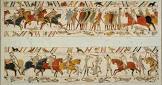
The extraordinary fuss over the Bayeux Tapestry (BT) finally being released on loan for viewings at the British Museum (BM), and criticism over the £800 million cost of insurance, have thrown the spotlight now on controversies about Welsh treasures.
There is an increasing belief that important artefacts from Wales (which reveal the rich cultural history of the country), should be viewed by more of the public, along with concern about the price which might then be incurred.
The UK Treasury insured the BT (a 70-metre embroidered cloth, which depicts the 1066 Norman invasion and Battle of Hastings), for damage or loss during its transfer from France, and while it is on display from this month.
It will back the cover under the Government Indemnity Scheme (GIS), an alternative to commercial insurance that allows art and cultural objects to be shown in the UK.
However art experts and conservators have voiced concerns about the loan due to the extreme fragility of the tapestry, with more than 76,000 people signing a petition to halt the exchange.
Didier Rykner, the high-profile French art historian who set up the petition, declared that the insurance valuation “obviously makes no sense”.

“Insurance must allow for the replacement of the insured object if it were destroyed. Which, in this extreme hypothesis, would obviously be impossible”, he said in an editorial in his publication, La Tribune de l’Art.
Mr Rykner said the indemnity “in no way represents real insurance”, and he questioned the “fine print” of the deal, but he said his efforts to query this with the UK Government had been unsuccessful.
He is not alone in raising the alarm.

The law firm Browne Jacobson has reported: “Conservationists are concerned about vibrations and shocks to the extremely fragile tapestry while on route to London. The British Museum and the French state have agreed on a maximum vibration limit of less than two millimetres per second on the journey. The normal movement of a well-designed truck would cause vibrations of about 45mm per second, with potholes and bumps causing further spikes“.
Issues like these have put centre stage worries about important Welsh treasures, and how, or if, they should be moved around as exhibits.
They include remarkable archaeological discoveries like the massive 60 Kilogram hoard of up to 15,000 Roman coins found in North Wales, alongside legendary artifacts managed by museums in Wales.

Notable recent discoveries are
- The North Wales Roman Hoard uncovered by metal detectorist David Moss and a friend, consisting of 10,000 to 15,000 third-century Roman silver and bronze coins, that is potentially the largest coin hoard ever revealed in Wales.
- The Margam Beach Shipwreck Hoard, recovered by detectorist Peter Hughes after storms shifted sand on a Margam beach, featuring 15th- and 16th-century gold coins from the Spanish and Portuguese reigns (including a rare gold São Vicente) alongside an unopened combination lock chest. on display at the National Waterfront Museum in Swansea.
- Regular discoveries have also included 15th-century gold fede rings, Bronze Age gold lock-rings with intricate hand-scribed concentric circles, and Tudor coin hoards.
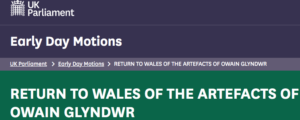 In the past, politicians have pointed to areas of concern in relation to Welsh treasures being taken out of the country altogether in the opposite direction to the BT, and that they should be brought back.
An Early Day Motion in the UK Parliament announced: “That this House believes that the artefacts of the previous Welsh Parliament should be returned to Wales; recalls that the Pennal Letter and Seal of Owain Glyndwr sent to France in 1406 are of great historical significance in Wales as rare treasures of Welsh history; and believes that they should be reclaimed from the French National Library and exhibited and honoured in Wales as tangible links between the Parliament of 1404 and the Assembly of today”.
So artefacts from many years ago have enormous significance today – and so do the controversies about them!
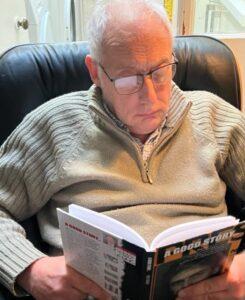
The memories of Phil’s astonishing 43 year award-winning career in journalism (when stories about artistic treasures were often reported) as he was gripped by the rare neurological disabling condition, Hereditary Spastic Paraplegia (HSP), have been released in a major book ‘A GOOD STORY’. Order the book now!
Tomorrow – campaigners want cleaner waterways in Wales after a landmark legal case to protect the rivers Wye, Lugg and Usk – the biggest ever claim of its kind, but which opponents say is “based on a misunderstanding”.