






- Another kill zone - 6th October 2026
- War games part one - 6th October 2026
- Poll to poll - 5th October 2026

During 43 years in journalism (when he was trained to use simple language, avoiding jargon) for our Editor, Welshman Phil Parry, choosing exact and easily-understood words has always been paramount, with the spotlight being thrown on this fundamental issue by a new book about the importance of punctuation, while another recent one uses terms known mainly in academic or student circles.
Exact (but not impenetrable) phrases, and correct punctuation MATTER!
I would like to think that after many decades in journalism (and the author of a book), I know this fundamental truth more than most.
Two writers have put this fact centre stage for me.
One emphasises the important role of punctuation, while another uses words which are dense and (probably) not understandable for The Eye’s imaginary reader; Mrs Jones in Rhyl.
There are phrases in this author’s recent book, like “…heterogenous anarcho-syndicalist…”.
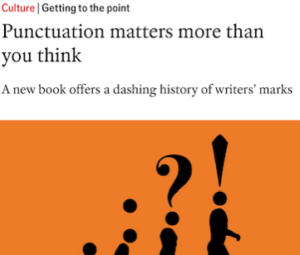
But in the work ‘On the Mark’, by Florence Hazrat (in an easily-understood manner), the vital function of punctuation is underlined.
“The history of punctuation is the history of humanity”, she argues.
It’s a rollicking good read – punctuation is often dismissed, yet it is in fact “the invisible ushers of the sentence”, dots and dashes have shaped religious texts, legal documents, and literature.
‘On the Mark’, like punctuation itself, makes readers pause for thought, showing how full stops have displeased and commas caused controversy.

However, key descriptions in another book took me right back to before I started in journalism – to my days at the University of Manchester (UoM) where I was from 1980 – 83.
Left-wing politics, and deep discussions about alternative forms of government, were all the rage then.
Several came also in the book ‘The Paris Commune in Britain: Radicals, Refugees and Revolutionaries after 1871′, and one description was that the commune had a “…heterogenous anarcho-syndicalist programme born of federations of citizen organisations, artist associations and neighbourhood networks”.

The author of this twaddle, Dr Laura C Forster was in the History faculty of the UoM (and as a student of Politics and Modern History [PMH] I had many of my tutorials there, although long before she arrived).
She declares online: “I am a historian of ideas and political cultures. Particularly I am interested in the social, emotional and spatial contexts in which political ideas are developed and exchanged.”.
Quite apart from these two comments being candidates for Pseud’s Corner in Private Eye, there are words in the first one which you almost never hear outside students’ bedrooms, or books like these. Therefore let’s unpack this a bit, if you can bear it!
We’ll start by looking at the label ‘anarcho-syndicalist’. ‘Anarcho-syndicalism’ is a branch of anarchism focusing on industrial action, using radical trade unions (syndicates) to fight capitalism and the state through direct action or general strikes.
It aims to establish a decentralised, stateless society managed by worker federations, and key features include working class solidarity, self-management, as well as anti-authoritarianism.

But how many people outside academic and student circles actually know this?!
What does Mrs Jones in Rhyl think of ‘anarcho-syndicalism’?!
It’s certainly not a term which you will find very often in my journalism on The Eye!
Here’s another one – apparently the idea of the commune was to “universalise power and property”.
Dr Forster writes about a different figure that ‘the commune emerges as a historic touchstone for municipalism – meaning socialised cities made through a “commitment to the provision of housing, infrastructure and public space for all”… and administered not via a top-down urban welfare state, but rather brought to life through radical direct action, by workers, social movements, unions and creative interventions’. Many pages are also devoted to the tiny sect of English Positivists, humanist and radical.

Reading all this I was transported to earnest, but totally worthless and meaningless, discussions about state control of private property.
Perhaps the writer here needs to take a leaf out of a journalist’s book and avoid jargon, or maybe she should read another more simple one, about the importance of punctuation!
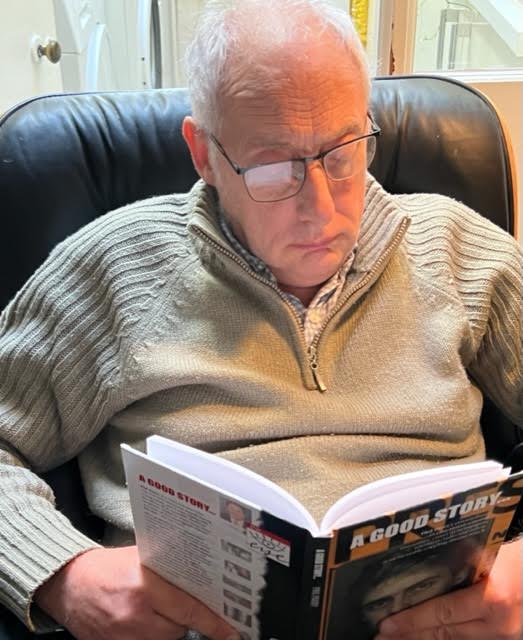
The memories of Phil’s astonishing award-winning career in journalism (when the use of accurate but ordinary words was central) as he was gripped by the rare neurological disabling condition, Hereditary Spastic Paraplegia (HSP), have been released in a book with correct punctuation ‘A GOOD STORY’. Order the book now!

‘The Paris Commune in Britain: Radicals, Refugees and Revolutionaries after 1871′ by Laura C Forster is published by Oxford. ‘On the Mark’, by Florence Hazrat, is published by Basic Books, and Profile Books.
Tomorrow – how during his long career, for Phil it has always been paramount to know where the political fault lines lie, and who is IN and who is OUT of favour, which is now shown in spades today by MORE splits in Donald Trump’s right wing MAGA (Make America Great Again) movement.