









- Halt! (Unless you’re a certain type…) - 16th September 2026
- From Russia without love part two - 15th September 2026
- ‘We don’t need no educashun…’ copyright Pink Floyd - 14th September 2026

After 23 years with the BBC, and 42 years in journalism (when he was trained to use clear and simple language, avoiding jargon), our Editor Phil Parry knows better than most that for an investigative journalist like him, relying on the Freedom of Information (FOI) Act almost NEVER works!
People think it is a solution for almost anything, but sadly it is not.
i am talking here about the Freedom of Information (FOI) Act which regrettably includes a legion of exemptions, and unfortunately on The Eye we have just had another example of this, relating to a well-known former broadcaster, who is said to be heartbroken over what has happened.
There may be more to the story about him than we have been told, so we decided to lodge an FOI to find out, knowing that, alas, the many caveats within it meant that it was unlikely further details would be divulged.
 Let’s look at those in a bit more detail:
- Absolute exemptions take in information which is available elsewhere (S21), security body data (S23), court records (S32), personal data (S40), confidential information (S41), and legal prohibitions (S44).
- Qualified exemptions (requiring a public interest test) embrace: future publication (S22), national security/defence/international relations (S24, 26, 27), investigations/law enforcement (S30, 31), policy formulation (S35), health and safety (S38), and commercial interests (S43).

But these aren’t the only ones, because other refusals can come on cost grounds.
 Information relating to communications with the Sovereign and to the heir and second in line to the Throne is absolutely exempt from it, and details which relate to other members of the Royal Household are subject to the public interest test.

“Could you please tell me –
“The MPS can neither confirm nor deny whether it holds the information that you requested as the duty in Section 1(1)(a) of the Freedom of Information Act 2000 (the Act) does not apply by virtue of the following exemptions:

• Section 30(3) – Investigations and proceedings conducted by public authorities
• Section 40(5B)(a)(i) – Personal Information
“To even confirm or deny that any other information is held by MPS, would, in itself, reveal whether investigations have or have not taken place. Any such disclosure under FOI would be considered a disclosure to the public at large and would be significantly harmful. Not only would it provide sensitive information to the public at large, but it would risk undermining anypotential investigations linked to this matter, revealing sensitive operational details, and identifying any individuals involved.
“This notice does not confirm or deny that the MPS holds the information that you have requested within questions 1 and 2 of your request.
“In accordance with the Act, this email constitutes a Refusal Notice for this request under Section 17(1) of the Act. A full explanation, including the relevant sections of the Act, is given in the section of this notice titled ‘Legal Annex’ …”
The police, it seems, were mindful of what information they could legally withhold, in an act which was put on the statute book to fulfil a campaign promise from the UK Labour Government. It is a pale imitation of the version in the USA.


On many occasions I have been called “vexatious”, so the request has been formally denied, and as we have seen, the police often prove particularly difficult.
The ironically-named ‘Disclosure Unit’ of controversial South Wales Police (SWP) have refused to give details of a huge alleged bribery investigation in which contentious Swansea University (SU) was at the heart.
It followed creation of the £200 million (much of it public money) ‘Llanelli Wellness and Life Science Village’ (Delta Lakes) project, rebranded as ‘Pentre Awel – Breezy/Windy Village’, and it formed part of the £1.3 billion Swansea Bay City Region Deal (SBCRD), which was run in partnership with SU as well as Hywel Dda and Abertawe Bro Morgannwg health boards. 86 acres of land at Delta Lakes had planning permission, and the giant venture was to have included research, with business development facilities, a state-of-the-art care home as well as an assisted living and rehabilitation centre, outdoor leisure space, a wellness hotel, and a new leisure centre.

But a statement about it from SU declared: “The police have confirmed to Swansea University that there was evidence of potential criminal offending identified and secured against individuals and companies subject to their enquiry…The university’s decision to dismiss (a key official) was based on serious breaches of Swansea University procedures and was never dependent on a criminal investigation by the police or decision to prosecute by the CPS (Crown Prosecution Service)“.

During the police inquiry, properties in Swansea, Carmarthenshire and Kent were searched. SWP said the Regional Organised Crime Unit (Tarian) executed “a number of warrants as part of an investigation into alleged bribery offences. Seven (then eight) addresses in Swansea, Carmarthenshire, and Kent are being searched with the assistance of colleagues”. The searches involved officers from SWP, Dyfed Powys Police and Kent Police forces, yet The Eye were alone in disclosing the properties raided by the police.

The SWP’s, so-called ‘Disclosure Unit’, though, seemed LESS willing to give this kind of information, through an FOI.
It said to us: “Your request has been considered and we are not obliged to supply…information.
“The following exemptions apply: Section 30(1) – Investigations and Proceedings Conducted by Public Authorities Section 40(2) – Personal Information”.
There was no luck either in getting information on this scandal from the CPS, to which the police report about it was sent.
An official in the CPS mis-named ‘Information Access Team’ declared: “On balance I consider the public interest favours maintaining the exemption”.
Unfortunately ‘maintaining the exemption’ seems to be the order of the day when it comes to an FOI request – so investigative journalists like me have to use other methods to bring out the news…
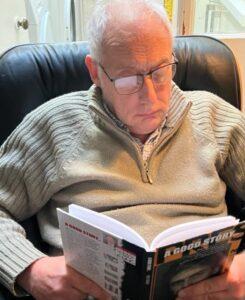
The memories of Phil’s astonishing, decades long award-winning career in journalism (which was pursued DESPITE refusals under the FOI Act) as he was gripped by the rare neurological disease Hereditary Spastic Paraplegia (HSP), have been released in a major book ‘A GOOD STORY’. Order it now!
Next week – disturbing news that TWO Welsh police organisations have been forced to pay huge amounts in damages over sex abuse investigation failings, when UK sex crime cases generally have more than tripled over the last two decades, shines the spotlight once again on the shortcomings overall of one of those forces (the biggest one in Wales), which was responsible for a string of miscarriages of justice, and may bolster the argument of critics who are angry that the small country of just 3.1 million people, has FOUR forces.