

- Halt! (Unless you’re a certain type…) - 16th September 2026
- From Russia without love part two - 15th September 2026
- ‘We don’t need no educashun…’ copyright Pink Floyd - 14th September 2026

During 23 years with the BBC, and in a 42 year journalistic career (when he was trained to use clear and simple language, avoiding jargon), for our Editor, Welshman Phil Parry, it has always been very important to point out the feet of clay of venerated individuals, and now this is emphasised by new research about Alexander the Great showing that he killed huge numbers of people.
It’s not always popular.
To a lot of my audience it is, apparently, bad form to point out the darker side of an extraordinary individual, or highlight the unsavoury aspects of a significant event.
So it is as well in all the miscarriage of justice programmes I have presented over the years, when some, it seems, feel that it is better to let sleeping dogs lie, and side with the police.
It is kind of ‘my country right or wrong’!
In the eyes of those people it is better, it appears, that ANYONE be convicted of a crime, never mind if it is the WRONG person!
I’m afraid I have never agreed with this, so I have become (almost) used to the abuse I suffer as an investigative reporter.
I believe that it is right to understand the TRUTH about individuals.
In my journalism I have also NEVER joined in the adulation of society about certain individuals, if I know details about his or her murky past.
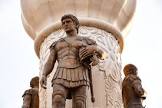
I have always had problems with the word ‘Great’.
It has always seemed to me that it is reprehensible (as well as extremely patronising), to use this soubriquet while ignoring the bad traits of someone.
‘Greatness’ is surely enhanced if ALL the characteristics of someone (both good AND bad) are known.
Others, it is clear, disagree with this view.
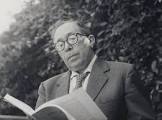
On hearing of the death of Churchill (who certainly deserves the title ‘Great’), the German-American political philosopher and historian Leo Strauss reminded his students that the most important duty of politics was to emphasise ‘greatness’.
He declared that we needed to put the study of ‘greatness’ back into the heart of education.
I have been put in mind of all of this (perhaps bizarrely), by new information coming to light about someone who has been put on the highest pedestal – Alexander the Great.
No one can be in any doubt of his powerful, and long-lasting, effect (he did, after all, conquer an empire of 4,800 kilometres, and up to 17 cities are named after him), but historians do not tend to dwell on the atrocities he committed.
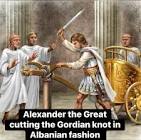 But ‘Alexander: God, King, Man’ by Edmund Richardson tells the truth about him.
He has been called “mad”, “Alexander the not-so-great”, and “one of the greatest killers the world had ever known”.
This is with good reason, as some have estimated that almost one per cent of the ancient world’s population died as a result of his campaigns.
Yet today he is seen as someone to look up to.
Even business books cite him as an example of good managerial practice.
One professor at INSEAD, a business school, wrote an article entitled “Eleven Leadership Lessons from Alexander the Great”.
It included advice to “Consolidate Gains” and “Invest in Talent Management”.
Perhaps there should also be a chapter headed: ‘Avoid Killing One per cent of the Known World’.
Never mind – I’m sure any abuse for what he did would be like water off a duck’s back to the man who cut the Gordian Knot.
Perhaps I should take a leaf out of his book!
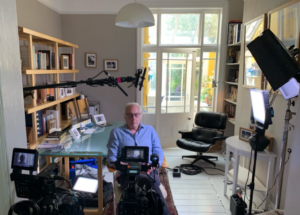
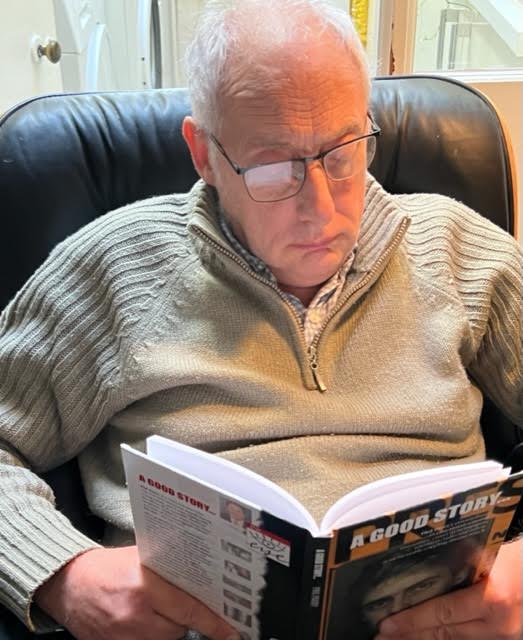
Truths like these by Phil about revered individuals, when he was being gripped by the rare neurological condition Hereditary Spastic Paraplegia (HSP), have been released in another book ‘A GOOD STORY’ (which includes details of some of the miscarriage of justice programmes he has presented). Order it now!
Alexander: God, King, Man, by Edmund Richardson, Bloomsbury; is to be published in America by St Martin’s Press in September.
Tomorrow – from ancient Greece (or Macedonia!) to Rome, and as Phil spent 23 years with the BBC,, he looks with interest at the recent attempts to justify the giant corporation’s licence fee, stressing all that it does, ahead of the UK Government’s review of its Royal Charter.