









- Halt! (Unless you’re a certain type…) - 16th September 2026
- From Russia without love part two - 15th September 2026
- ‘We don’t need no educashun…’ copyright Pink Floyd - 14th September 2026

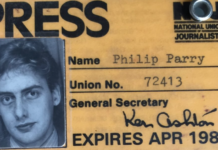
For our Editor, Welshman Phil Parry (as with ALL journalists), it is important to know that in any story the writing is original, and not written by Artificial Intelligence (AI), and now, thankfully, comes news of systems today which can SPOT what comes from a machine!
Whatever you read on The Eye comes from ME!
Every story is original, all the sources are checked, and a lawyer invariably looks at the meaning of each word.
This is important as so much material today is written by Artificial Intelligence (AI) which is a problem for journalists, school teachers and lecturers; indeed for everyone who relies on the written or broadcast word.

Now, though, there is hope, because they have developed systems which can SPOT stuff which has been created by AI.
AI prose in Large Language Models (LLMs) is distinguishable by word and punctuation choice as well as sentence and paragraph structure, but its hallmarks are not what you might expect, partly because its writing style has changed with software updates.

That does not mean that LLMs are great writers: their prose lacks lucidity and elegance, so is often formulaic.
Therefore those aspiring to be impressive (human) storytellers should avoid these peculiarities in their own prose.
However this can now work to the advantage of people who want original, human-inspired, writing.


For example, consider the words now used because the vocabulary that bots overuse has changed: they no longer ‘delve’ and there are not as many ‘tapestries’.
Instead they offer a significant number of polysyllables like ‘significant’, ‘increasingly’ and ‘consequences’.
They use more rare words such as ‘interdependence’, and ‘reindustrialisation’, as well as scientific lingo (‘parameter’, ‘methodology’) than humans, and are fond of nominalisations (making nouns from verbs, such as ‘expansion’ out of ‘expand’).
All the LLMs in a recent study used such words, but particularly Gemini and Claude.

So if you want to spot AI writing, look for bland, pretentious prose lavished with Latinate words (at least for now).
We need to keep on top of things as AI is becoming cleverer all the time. With every update AI writing is developing so that it is more and more similar to human prose.
LLMs are trained on human writing and learn from human feedback, notes Tommie Juzek of Florida State University (FSU).
They pick up things they think people find impressive and drop the things they believe people do not.
Bots learn fast, too. Take ChatGPT: until very recently it used an em-dash in almost every sentence.
When I asked an older model whether it thought AI overused the dash, it said: “Ha—great question!”. Ask the bot the same thing today and it soberly says “they’re best used sparingly”.

At least you can be sure that this and other pieces on The Eye are not written by AI,
I do use the dash though…
The memories of Phil’s decades-long award-winning career in journalism as he was gripped by the rare disabling condition Hereditary Spastic Paraplegia (HSP), have been released in a major book ‘A GOOD STORY’ (which was NOT written by AI!). Order it now!
Soon on The Eye – as AI grows apace (with 80 per cent of Britons now saying they use it at work), concern is mounting over how minority or non-English languages will fare, as one database records only Swahili above Welsh, in a register of ALL African languages.
Tomorrow, how for Phil during that career spotting trends was crucial, and today a new one could be emerging – in the rise of cheeses!