


- Another kill zone - 6th October 2026
- War games part one - 6th October 2026
- Poll to poll - 5th October 2026
During 23 years with BBC Cymru Wales (BBC CW), and a 43 year career (when he was trained to use clear and simple language, avoiding jargon), a key aspect of our Editor, Welshman Phil Parry’s journalism would be always knowing about important anniversaries for stories, but this year marks the centenary of a major one, which has not been noted properly, and where Wales’ role was central – the General Strike.
Dates can be tricky, but they are crucial.
As a journalist you should have a working knowledge of when something happened, so that on anniversaries you can write about it.
On key dates (like one year, 10 years, or 100 years after the event happened), experts or survivors should be tracked down, and interviewed about it.
There would then be programmes, it would be written about on websites, and on the day itself news pieces would be produced.
It seems bizarre, then, that we have heard next to nothing about a significant one, where Wales was absolutely central, and it stands in stark contrast to the 1984-85 miners strike – the 1926 General Strike.
OK, there have been a handful of academic books published, left wing T-shirts printed with clenched fists, and lectures given to mark the occasion, but nothing like what you might expect for such a big event.
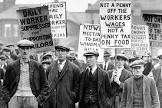
It is surely unlikely that this is because, while it was highly successful at the start (almost three million people stopped working, 20 per cent of the adult population, in support of the miners), it ended in failure and unconditional surrender (although the miners fought on for MONTHS), as the 1984-85 miners strike was much the same (but there was NO UK-wide stoppage).
So why is it?
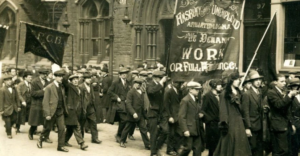
Let’s look back at some of the facts.

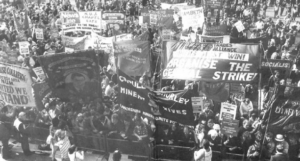
With mining communities already struggling, the shutdown beforehand had pushed them to the edge.
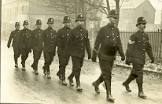
Police presence increased, especially around collieries and railway lines, as tensions simmered.
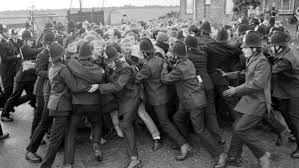
The 1984-1985 strike was a huge thing, with the twists and turns of it being reported daily.
I have been on picket lines and seen the terrible violence committed by miners, as well as by the police, when attempts were made to stop (or allow) people to go to work.
I have also reported on the awful poverty of striking miners’ families, the devastating effects on South Wales Valleys communities, as well as the suffering of police officers involved, as they were hit by Post Traumatic Stress Disorder (PTSD).

I remember taking a call in the newsroom from an official of the National Union of Mineworkers (NUM) who went on to become a UK Government minister, advising us of where the flying pickets would be that day.
The miners were fighting for their jobs and their communities, but many of them KNEW their mine was on its last legs.
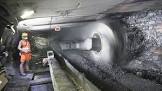
One of them said to me: “We all realised the pit was exhausted. We’ve been digging up mud for ages!”.
The media was HATED (particularly the London-based press), and it always seemed strange to me when this hatred was directed towards what I was doing, because I represented a paper that was a long way from London (the South Wales Echo [SWE]), and a lot of our readership came from valleys communities so we were keenly aware of the issues involved.
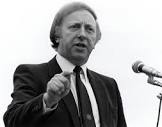
The strike though went on and on (as did the miners’ walk-out following the General Strike), and the fatal flaw for its leader Arthur Scargill (along with the ultimate reason for its failure), was that he didn’t call a UK ballot.
I remember a friend of mine saying he covered the strike with miners playing football in the sun, then huddled round a brazier, then in the spring sunshine again. Three deaths (including one in South Wales) resulted from events related to the strike.
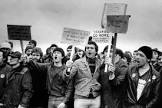
People tend to forget that the strike effectively ended in South Wales.
Until almost the end the strike had been virtually rock solid there, but when miners voted at Porthcawl Pavilion to go back to work (which I also covered) – that was it. It was over.
Many observers and commentators regard it as “the most bitter industrial dispute in British history”.
The journalist Seumas Milne (who became a key adviser to Jeremy Corbyn) said of the strike that “it has no real parallel – in size, duration and impact – anywhere in the world”.
Mr Milne was flat wrong on a lot of things, but right on this.
At least all of this was put into the public domain at a key anniversary.
However the General Strike hasn’t been covered as it should have been at all!
The memories of Phil’s astonishing decades-long award-winning career in journalism (including details of his time on the SWE) as he was gripped by the rare disabling condition Hereditary Spastic Paraplegia (HSP), have been released in a major book ‘A GOOD STORY’. Order it now!
Next week – the backlash is growing even more today, following news that disgraced former BBC presenter Huw Edwards is on a media outlet after he admitted accessing sickening images of underage children, and his writing a poem for the National Eisteddfod.