


- Exam nerves - 9th October 2026
- Degree of pain - 9th October 2026
- Writing on the wall? Part one - 8th October 2026
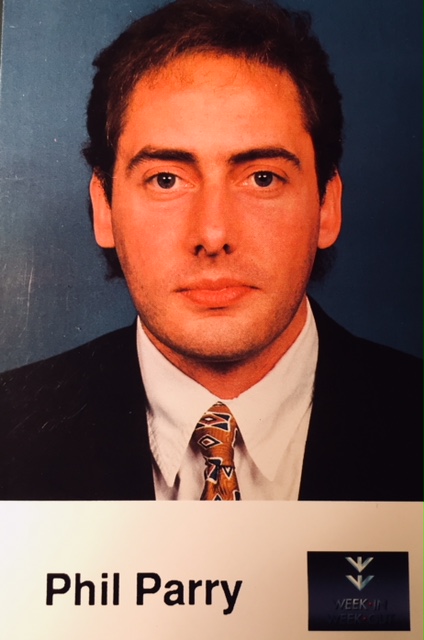
During a 23 year career with the BBC, and 43 years in journalism, (when he was trained to use clear and simple language, avoiding jargon), for our Editor Welshman Phil Parry, it has always been fascinating to watch things go in and out of fashion – and now this is underlined by hard testing of children in tough exams today apparently making a comeback, with one of the hardest of all completed this month; to gain entry to an Oxford college attended by a controversial former Welsh Secretary.
Cambridge academics call it ‘Arseholes’.
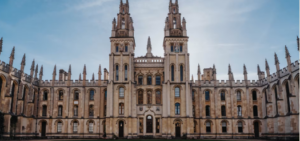
It’s actually ‘All Souls’ in Oxford, and the entrance exam (which finished this month) is reckoned to be one of the hardest in the world.
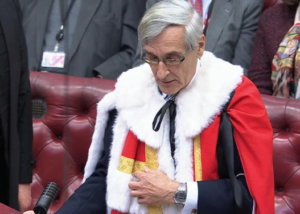
Among its many famous alumni is the former Secretary of State (SoS) for Wales, Sir John Alan Redwood, Baron Redwood, better known to most, perhaps, as plain old John Redwood, who, presumably, will support this kind of rigorous testing.
In the UK Government reshuffle of May 1993, Lord Redwood was appointed to the cabinet as SoS for Wales, and stayed in the job for two years.
It seems a shame that his noted education did not prevent him committing apparent gaffes, such as attempting to mime the Welsh national anthem at the Welsh Conservative (WC) party conference, when he didn’t know the words, although, in fairness, he subsequently learned them.
Lord Redwood gained a somewhat haughty reputation with, some said, a disregard for Welsh national feeling; and it did not endear him to several in Wales when he returned £100 million of the block grant to the Treasury unspent in 1995.
The All Souls entrance exam, which this year finished on October 1, has been called ‘the SAS of academia’, and traditionally asks a one word question. Each year over 100 students, most of them recent graduates of Oxford, sit its four papers (two general, two specialist), each lasting three hours, over the course of two days.
Two students alone will win the glittering prize of a seven-year fellowship at the college, and depending on your view, the exam is either a demanding tool to distinguish “Genius” (1935 exam question) or an intellectual “Error” (1993 exam question).
At all events, this kind of challenging task has been thrown into sharp relief, by the disturbing Programme for International Student Assessment (Pisa) results, where, it would seem, many of the countries at the top had this kind of rigorous testing (although not with a singe word!).
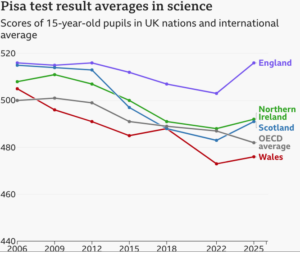
The publication of the Pisa results, showed Welsh teenagers’ scores had fallen further behind 15-year-olds in other UK nations, and the Welsh Education Minister Anna Brychan stated that Wales’ scores were “not where we want them to be”.
A measured, diplomatic, response it would seem, but Ms Brychan also proclaimed darkly: “…I believe that these results are really catastrophic for Wales”.
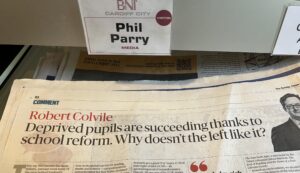
The Sunday Times declared: “England is…comprehensively outperforming not just Wales, Scotland and Northern Ireland but almost all of its international rivals”.
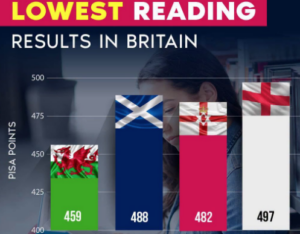
In reading, 31 per cent of the Welsh pupils who took the test scored below what is considered to be the required level to participate effectively in society – a significantly larger proportion than in other UK nations.

 Ms Brychan was damning, warning that young people: “…are going to struggle if there are so many in Wales who can’t participate (in the jobs and universities markets) through their reading”.
In Maths, 36 percent were below baseline levels.
Overall, Pisa had shown a general decline in performance.
 The much-vaunted Welsh-language educational system (and I declare an interest here because both of my children have been educated through the medium of Welsh), didn’t do very well either.
John Jerrim, Professor of Education and Social Statistics at University College London (UCL), said that over several rounds of Pisa, tests taken in Welsh had scored much lower.
But, this time, they had been about 70 marks lower in Welsh, with scores about 400 on average, he said.
He has called Wales’ Pisa results “sobering”, and he said there was a substantial gap between Wales and England’s top-scoring pupils.
“Those higher achievers seem to be doing much, much better in England than their equivalents in Wales“, he warned.
It is, possibly, small consolation, that some nations (notably France) did just as badly as Wales, while others did EVEN WORSE!
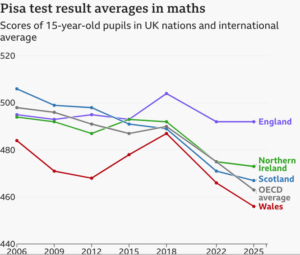 Wales performed below Sweden and Slovenia, yet above Malta in science; below Italy and Turkey, and above the Netherlands in reading; but below Belgium or New Zealand, and above Vietnam in maths.
Predictably, perhaps, teaching unions warned against seeing the Pisa results as the only measure of Welsh education.
Nicola Fitzpatrick, secretary for the National Education Union Cymru (NEUC), said the results “represent just one narrow measure and they should not be seen or used as a definitive benchmark for education quality across Wales”.
Unfortunately, it is a benchmark which is shown around the world – maybe the All Souls entrance exam has something to teach Wales?
Even if it is known as ‘the SAS of academia’…
The memories of Phil’s decades long award-winning career in journalism (when education stories were crucial) as he was gripped by the rare neurological condition, Hereditary Spastic Paraplegia (HSP), have been released in a major book ‘A GOOD STORY’, Order it now!
Next week – why today we are seeing more absurd examples of ‘BREAKING NEWS’ on media outlets, yet he always believed that this label should only be employed rarely, and even then just put on significant stories, but items this year have revealed a continued ridiculous use of the term, with one Cardiff-based news website even having a ‘Breaking news editor’!