




- Flavour of the month… - 8th October 2026
- Writing on the wall? Part one - 8th October 2026
- Lights to green… - 7th October 2026
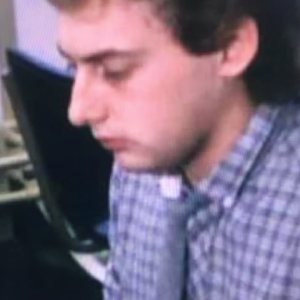
After describing how he was helped to break into the South Wales Echo office car, recalling his early years in journalism at the start of a 43-year career, the importance of experience in the job, making clear that ‘calls’ to emergency services and court cases are central to any media operation, as well as the vital role of the accurate quotation, here our award-winning Editor Phil Parry describes the significance of traditional reporter methods – particularly how writing may be making a comeback today, because records of crucial conversations in a notepad are difficult to hack.
In this brave new age of Artificial Intelligence (AI), it may be advisable to go ‘back to basics’ (to coin a phrase used ill-advisedly by John Major).
There are signs that this could be happening now, with a rise in writing (particularly cursive).
For a journalist this is fascinating, and the renewed interest in this skill might be to do with the fact that it is difficult, if not IMPOSSIBLE, to hack.
Before moving on to my newspaper, the South Wales Echo (SWE) in 1983, I was trained in basic journalism for five months at a centre in Newcastle.
There I was taught to write shorthand in a notepad, and had to reach 100 words per minute (wpm) (the industry standard), in order to pass a critical exam set by the National Council for the Training of Journalists (NCTJ).

The beauty of this system (if it’s done properly) is that it is virtually fool-proof, so accuracy is assured (Earl Spencer please take note!). For others too it has proved important.
Piers Morgan may be an acquired taste but his views are certainly important to all journalists.
He was a former Editor of the Daily Mirror who is now a TV presenter, and was named the most influential journalist on social media by the UK Press Gazette (UKPG), and he has championed the use of shorthand.


He said: “Having an ability to take fast contemporaneous handwritten notes as a back-up to technology is invaluable.
“I still use Teeline (a shorthand system) on Good Morning Britain during a big breaking news story live on air when I want to make a note of a powerful quote, and repeat it very soon afterwards”.
Mr Morgan also offered a cautionary tale about relying on technology: “Tape recorders are great until they don’t work, as I once discovered when I interviewed Rod Stewart for an hour and later could only hear my voice…”
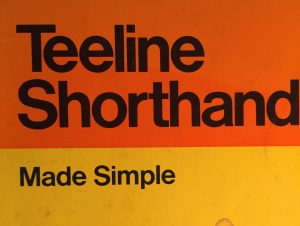
Teeline, which I use, as opposed to the more challenging Pitman variation, was developed by the Bradford schoolteacher James Hill, who wanted to come up with a quicker and more straightforward method of note-taking, and he began experimenting as early as 1939.
Decades later he saw some promising results when he taught experimental classes to journalism trainees.
In 1968 the system was recommended to the NCTJ, and its shorthand consultant Harry Butler has written: “We have on our hands a shorthand breakthrough which should solve longstanding shorthand problems. I have never known a shorthand system that can produce such good results in so short a time.”
All of this has been put centre stage for me by what could be taking place today – a return to WRITING THINGS DOWN rather than just using a computer.
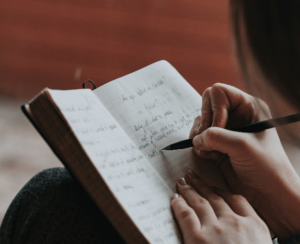
This phenomenon is embodied in the apparent rise today of CURSIVE writing.
The United States of America (USA) is particularly keen on this style of loopy handwriting.
In 2010 the country’s ‘Common Core’ curriculum shunned cursive in favour of keyboard skills, but, since then, more than half of states have brought it back to the classroom.

This school year Pennsylvania and New Jersey joined Texas, California, Florida as well as others in mandating the teaching of cursive in schools.
Other countries are underlining the importance of handwriting, too.
Canadian and Argentine provinces have reinstated cursive or started teaching it at younger grades.
In the UK, where cursive is taught from around the age of seven, policymakers introduced a revamped ‘writing framework’ in 2025 to improve handwriting instruction.
Italy and Sweden are moving away from tablets and screens to use books and handwritten notes.
In other places cursive has long been a coveted skill, and in France educators often teach ornate cursive script, while in Vietnam handwriting and calligraphy classes are surging in popularity.
Its return is supported by science, and lawmakers cite research about the benefits of handwriting on everything from memory to critical thinking, or fine motor co-ordination.

One study by Audrey van der Meer, a neuroscientist at the Norwegian University of Science and Technology, (NUST) compared the brain activity of children and young adults when they were writing in cursive, drawing and typing.
She found that the brain is engaged “in a completely different way” when handwriting and drawing, with scans showing activity in areas associated with learning and memory. Other studies have shown that cursive has other benefits, including boosting reading skills and spelling.
 In Wales there is a huge drive by the Welsh Government (WG) to boost basic writing skills, with the strategy underpinned by a strong move to support, as well, the Welsh language.
The WG declares: “Our Welsh Language Skills Strategy outlines how we will maintain a sufficient bilingual workforce in order to provide an effective Welsh language service in Wales”.
So writing (as well as shorthand) MATTERS, perhaps now more than ever!
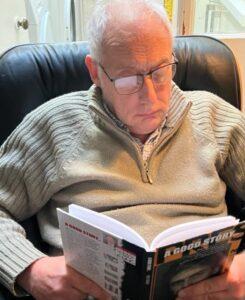
The memories of Phil’s decades-long award-winning career in journalism as he was gripped by the rare disabling condition Hereditary Spastic Paraplegia (HSP), have been released in a major book ‘A GOOD STORY’ (which was NOT written by AI!). Order it now!
‘Writing on the wall? Part two’ comes soon, where we look at how a new history of the pen has just been published.
