




- Writing on the wall? Part one - 8th October 2026
- Lights to green… - 7th October 2026
- School’s out - 7th October 2026
As our Editor, Welshman Phil Parry has written many times a free and independent media is essential in a society, although this does not exist in many states around the world, and this is now put centre stage by another food scandal emerging in China, where a cancer-causing chemical was used to wash cabbages.
Unless you allow a free and independent media to look into issues (like The Eye), more and more scandals will develop, and this culture of secrecy will allow them to fester.
A case in point is China, where yet another food scandal was revealed (by someone using the internet).

On August 22 a blogger posted videos of truckers in Kangbao, a county a few hours’ drive from Beijing, dipping cabbages in formaldehyde, which is used to keep their pale green leaves looking fresh on their journeys through the summer heat.
But formaldehyde can also cause cancer, so there was an outburst of national outrage, and embarrassed authorities set up checkpoints to test cabbages leaving the county.

So far three people have been detained on criminal charges, and countries such as Singapore and South Korea have stepped up inspections of Chinese cabbage imports.
It hasn’t just been vegetables either in the past.
More than 900 people were detained for “meat-related offences”, with one alleged gang suspected of using illegal chemicals to transform rat, mink and fox meat into counterfeit mutton slices – popular for their use in hot pot – and selling them to local markets.
Few things anger China’s public as much as food-safety scandals, and many are still haunted by a case in 2008 when tainted milk powder made some 300,000 children ill and killed six.
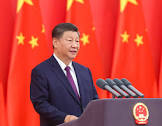
In 2013 Xi Jinping, China’s leader, tied the legitimacy of the Chinese Communist Party (CCP) to the problem, declaring: “If our party cannot even ensure food safety, then people will start to question whether we are qualified to govern”.
Yet the scandals have continued, and as China grows more powerful and sophisticated, the problem becomes more humiliating. People can buy cutting-edge homegrown robots, electric cars and smartphones, but they still do not trust their country’s food!


If this latest food scandal had not been revealed by a blogger, then you are bound to wonder whether it would EVER have come out, because the Chinese authorities allow only state-controlled media. How many more food controversies are out there which we DON’T know about?!
One journalist, who works for The Economist had trouble reporting on the whole affair. Shortly after the correspondent arrived in the county at the heart of it all, four officers appeared in a police car, followed by another clutch of officials from the propaganda bureau.

They were eager to talk about the fine weather and a rare species of bird that breeds nearby, they did not, however, want to answer any questions about cabbages.
This is not the only time when we have only been told about huge events, because details have been posted on the internet.
Recently a small plane slammed into Beijing’s tallest skyscraper, killing the pilot – the only person on board – and wounding 13 others, but it was all hushed up so nobody knows exactly what happened.
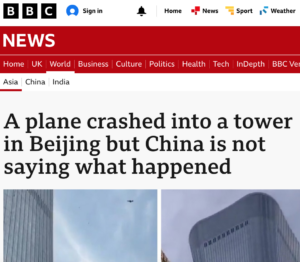 A 60-word ‘report’ detailing the basic facts in the state-owned Beijing Daily was the only official statement China published at the time of the crash, which happened just a few kilometres from Zhongnanhai, the headquarters of the Chinese Communist Party (CCP).
The collision left holes on the side of the 109-storey CITIC Tower, which have since been boarded up, and dramatic footage of the incident has been scrubbed off the internet.
The Chinese people themselves know little about what took place, and staff in the building, which is known as ‘China Zun’ after a Bronze Age jug that inspired its design, were told not to talk to anyone about the incident.
At least three aviation firms said they were told to suspend light aircraft operations, but they declined to elaborate, saying they had been instructed not to discuss it.

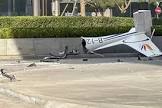
Later we heard from official state sources that the pilot was suffering from “chronic insomnia and anxiety” committing the terrible action for “personal reasons”.
He apparently was a divorced man who lived alone, the Chaoyang district government said in a statement, adding that his diary contained “multiple expressions of ending his life”.
“The comprehensive investigation concluded that this was a case of endangering public safety caused by personal reasons”, the statement said.
But how far do we believe this, because without a free media (like The Eye) to scrutinise this comment, and bring out the facts, WE SIMPLY DON’T KNOW?!
China is no stranger to censorship.
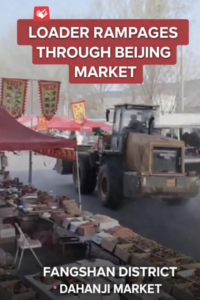
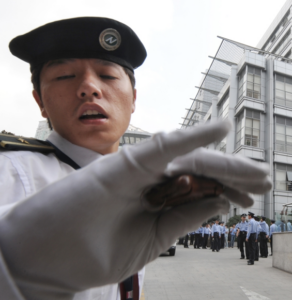
Even before trying to look into the cabbages story, when The Economist visited the site of a market at Fangshan where a construction vehicle had crashed, it was surrounded by dozens of police officers and local volunteers wearing the red armbands typical of CCP members.
A vehicle from China’s SWAT police was parked nearby, and when asked, a police officer refused to confirm that anything had happened at all.
But he did say that IF there had been an attack, mental illness would probably have been to blame (as in the aeroplane incident), and the perpetrator would no doubt be in custody. because “China’s police are very effective”.
Direct criticism of the party, the country’s leaders, or the government itself is banned, and any discussions that are deemed to have political implications, or touch upon sensitive issues quickly disappear, although this time it appears that the authorities went much further.
Photographs and memes of the skyscraper, which are unrelated to what happened, were removed from Chinese social media platforms.
The censorship machinery kicked in so quickly and thoroughly this time possibly because Beijing’s leadership is “still not exactly sure what happened”, says Manya Koetse, who runs the Eye on Digital China newsletter.
Beijing also recently tightened regulations on drones, citing security concerns – drones now have to be registered before they can be brought in and out of the capital.
Chong Ja Ian, a non-resident scholar at Carnegie China, declared: “This is a bit of an embarrassment to the security services responsible for Beijing“.
Perhaps because of this embarrassment, China went beyond what it has done in the past.
For example, historically it has blanked out prison camps on online maps, only for diligent researchers to find them again by looking at the empty spaces!
According to Kenneth Roth, a former head of Human Rights Watch (HRW), China has become the greatest “threat to the global human-rights system”.
Threat or not, it is clear that the authorities felt that telling the truth about a plane crash, and allowing a free media to report on cabbages washed in formaldehyde, would certainly put at risk the CCP’s grip on power in China…
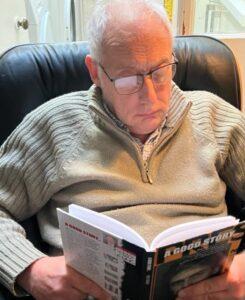
News, including stories like these by Phil, as he was gripped by the rare neurological condition Hereditary Spastic Paraplegia (HSP), have been released in a major book ‘A GOOD STORY’. Order it now
Next week – recent right wing unrest around the world against immigrants, has focused attention on how FEW people from overseas live in Wales, as well as the economic and cultural benefits they bring to the country, amid concern that the demonstrations might spread.