



- More Artificial Information (AI) part three - 22nd October 2026
- Old and new… - 21st October 2026
- Black European - 21st October 2026

After writing about the growing concern that we may be being deceived by politicians who use Artificial Intelligence (AI), our Editor, Welshman Phil Parry, looks on with alarm as more evidence emerges of how the democratic process could become distorted in important elections next week.
It almost beggars belief.
It appears that attempts have been made to paint the rival to Benjamin Netanyahu in next week’s Israeli elections (Gadi Eisenkot) as a left wing extremist, who would favour the Palestinians.

A picture circulated online of Mr Eisenkot meeting Mahmoud Abbas, a Palestinian politician who has been serving as the second president of Palestine and the Palestinian National Authority (PNA) since 2005.
He has also been the fourth Chairman of the Palestine Liberation Organisation (PLO) since 2004. Mr Abbas is, too, a member of the Fatah party and was elected Fatah’s Chairman in 2009.

This would, perhaps, subvert a major democratic election, with the latest opinion poll putting Mr Eisenkot’s party (Yashar) in the lead.
It was, though, completely FAKE and generated by Artificial Intelligence (AI).
This extraordinary episode shows the difficulty for journalists in covering politics (or anything!), as we simply do not know what is right and what is not.

New research has also shown that a lot of speeches, and other events, are actually generated by AI.
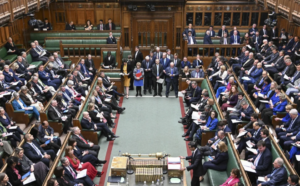
An investigation by The Economist has found that one in 10 of the words spoken in debates at the UK Parliament are drafted by AI, and that share is rising, from near-zero in 2024.
One MP, a quarter of whose speeches appear to be AI-written, denied using the technology altogether at work, and added that he and his parliamentary assistant “do have a bit of a running joke, though, that his writing style often uses some of the AI-generated tropes”.
The UK Parliament or events in the Israel election campaign, are not the only ones either, and we do not know as well, how many speeches in the Welsh Parliament/Senedd Cymru (WP/SC), or other constituency work comes from AI, but it is likely to be significant.
In English-speaking legislatures, the heaviest AI-users are Australian and Canadian MPs, whose speeches get flagged (as possibly AI-generated) at triple the rate of British ones.
Members of the House of Representatives (HoR) in the United States of America (USA) are not far behind.
Across the pond, the House of Lords (HoL) despite its fusty reputation, in fact uses more AI than the House of Commons (HoC).
The lowest-AI chambers sampled in their investigation were the New Zealand House and USA Senate.
So where does that leave the WP/SC?
We do know that firm evidence of this practice emerged three years ago with one Member of the Senedd (MS), but what we don’t know is how much happens NOW.
In 2023 Welsh Conservative (WC) MS Tom Giffard used Chat GPT to write a speech congratulating Wales for winning the World Cup of Darts, admitting the speech ended a little oddly when he declared “long live darts“.

This tool, from OpenAI, is trained on information from the internet and can answer questions from users.
In a 90-second statement in the WP/SC, Mr Giffard said the team of Gerwyn Price and Jonny Clayton “showed incredible skill, nerve and teamwork throughout the tournament”.
He defended himself by alleging that he made the speech “to show just how advanced the technology is becoming”, and he told the WP/SC it was written with the software.
Mr Gifford declared: “The fact the AI could write a whole speech that can be delivered in a Parliament shows the potential of the technology, as well as the potential pitfalls for future legislators.”

‘Potential pitfalls’ is right – both for an investigative journalist like me (when evidence might be fake because it was created by AI), and for democracy itself, as disturbing events before the Israeli election have shown…
The memories of Phil’s decades-long award-winning career in journalism as he was gripped by the rare disabling condition Hereditary Spastic Paraplegia (HSP), have been released in a major book ‘A GOOD STORY’ (which was NOT written by AI!). Order it now!